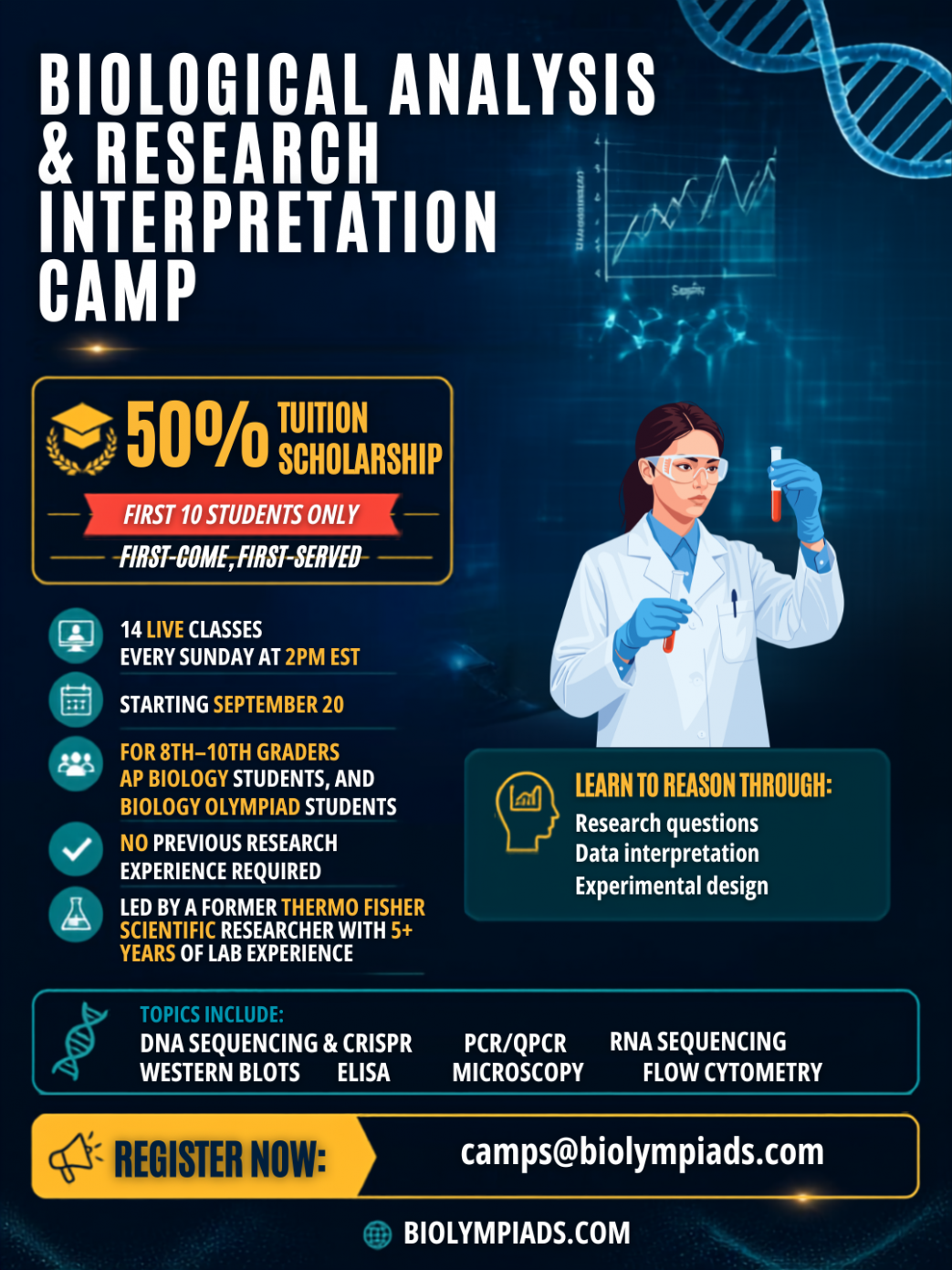
As you know, for the Biology Olympiad knowing biology is not enough. Students need to know how to think through biological evidence. That is exactly what we will train in our new Biological Data Analysis & Research Interpretation Camp.
Special 50% Tuition Scholarship
To make this new program accessible to more motivated students, Biolympiads.com is offering a 50% tuition scholarship to the first 10 students who enroll in the Biological Data Analysis & Research Interpretation Camp.The scholarship will reduce the full program tuition by half and will be awarded on a first-come, first-served basis. If you are interested in joining the camp, we encourage you to register early, as only 10 scholarship spots are available.
About the programme
Over 14 live classes, students will learn how to approach unfamiliar research data the way a scientist does:
- What was the research question?
- Why was this experiment performed?
- What are the controls?
- What does the data actually show?
- Which conclusions are justified?
- What experiment should come next?
Students will work with real research-style data and figures, including:
• DNA sequencing and CRISPR experiments
• PCR and qPCR
• RNA-Seq, heat maps, and volcano plots
• Single-cell RNA sequencing, UMAP, and t-SNE
• Western blots and ELISA
• Microscopy and immunofluorescence
• Flow cytometry
• Signaling pathways and protein networks
• Experimental design, controls, and scientific reasoning
The emphasis is not on memorizing another mountain of biology. It is on learning how to reason through an experiment even when the student has never seen that exact experiment before.
What Students Will Learn
Module 1 — Foundations of Scientific Data Analysis
Class 1: How to Read a Scientific Research Paper
Students will learn how scientific papers are organized and, more importantly, how scientists actually read them.
Topics include:
- Abstract, Introduction, Methods, Results, and Discussion
- Identifying the central research question
- Recognizing hypotheses and predictions
- Separating experimental evidence from interpretation
- Understanding how figures support scientific arguments
- Evaluating whether conclusions are supported by the data
Activities: Students will work through a research paper, identify the research question and key experiments, and attempt to predict conclusions from the data before reading the authors’ interpretation.
Class 2: Experimental Design, Variables & Controls
A result is only as convincing as the experiment that produced it.
Students will learn to evaluate:
- Independent and dependent variables
- Positive controls
- Negative controls
- Experimental controls
- Sample size
- Biological vs. technical replicates
- Confounding variables
- Sources of experimental bias
- Correlation vs. causation
Activities: Students will critique experimental designs, identify missing controls, detect weaknesses, and propose improved experiments.
Module 2 — DNA Analysis & Genomics
Class 3: DNA Sequencing Data
Students will explore how scientists determine and compare DNA sequences.
Topics include:
- Sanger sequencing
- Next-generation sequencing concepts
- DNA sequence chromatograms
- Sequence alignment
- Mutation identification
- Substitutions, insertions, and deletions
Figures analyzed: sequencing traces, DNA alignments, and mutation data.
Students will practice identifying mutations and determining their possible biological consequences.
Class 4: Genomics & Comparative DNA Analysis
Students will move from individual DNA sequences to genome-level analysis.
Topics include:
- Genome organization
- Genome maps
- SNPs
- Structural variants
- Comparative genomics
- Sequence conservation
- Phylogenetic relationships
Figures analyzed: genome browser-style tracks, comparative sequence data, and phylogenetic trees. Students will use genomic evidence to infer evolutionary and biological relationships.
Class 5: CRISPR & Gene-Editing Data
Students will learn how researchers determine whether a gene-editing experiment actually worked.
Topics include:
- CRISPR-Cas systems
- Gene knockout experiments
- Gene knock-in experiments
- Genotyping
- Experimental validation
- Connecting genotype with phenotype
Figures analyzed: genotyping gels, sequencing validation data, and gene-editing experiments. Students will interpret CRISPR experiments and evaluate evidence for successful gene modification.
Module 3 — RNA Analysis & Transcriptomics
Class 6: Gene Expression Fundamentals
Students will learn how scientists measure changes in gene activity.
Topics include:
- Transcription and mRNA
- Gene expression
- Relative expression
- Fold change
- Controls and normalization
- Interpreting expression differences
Figures analyzed: bar graphs, scatter plots, and gene-expression comparisons.
Class 7: RT-PCR & qPCR Analysis
Students will develop practical skills for interpreting one of the most widely used molecular biology techniques.
Topics include:
- Reverse transcription
- PCR and quantitative PCR
- Amplification curves
- Ct values
- Reference/housekeeping genes
- Relative expression
- Fold-change calculations
Activities: Students will calculate relative gene-expression changes and interpret qPCR experiments.
Figures analyzed: amplification curves and expression graphs.
Class 8: RNA-Seq & Transcriptomics
Students will progress from measuring individual genes to analyzing thousands of genes simultaneously.
Topics include:
- RNA sequencing
- Gene-expression profiling
- Differential gene expression
- Upregulated and downregulated genes
- Statistical significance vs. biological significance
- Patterns across experimental conditions
Figures analyzed:
- Volcano plots
- Heat maps
- Expression matrices
- Gene-expression profiles
Students will practice extracting biological conclusions from large-scale datasets.
Class 9: Single-Cell RNA Sequencing
Modern biology increasingly studies individual cells rather than averaging signals across entire tissues.
Students will be introduced to:
- Single-cell sequencing
- Cell populations
- Gene-expression signatures
- Cell clustering
- Identification of cell types
- Developmental trajectories
- Cellular heterogeneity
Figures analyzed:
- UMAP plots
- t-SNE plots
- Cell-cluster maps
- Marker-gene expression plots
Students will learn how researchers use gene-expression patterns to identify previously unknown cell populations.
Module 4 — Proteomics & Protein Analysis
Class 10: Protein Detection Techniques
Students will learn how proteins are detected and quantified experimentally.
Topics include:
- Western blotting
- ELISA
- Immunofluorescence
- Antibodies
- Protein expression
- Experimental controls
- Quantification and normalization
Figures analyzed: Western blots, protein-expression graphs, ELISA data, and fluorescence microscopy images.
The emphasis will be on interpreting the experiment rather than simply memorizing how each technique works.
Class 11: Mass Spectrometry & Proteomics
Students will be introduced to large-scale protein analysis.
Topics include:
- Protein identification
- Peptide analysis
- Protein quantification
- Mass spectrometry concepts
- Proteome-wide experiments
- Comparing protein abundance between conditions
Figures analyzed: protein-abundance plots, peptide data, and proteomic comparisons.
Class 12: Signaling Pathways & Protein Networks
Students will learn how researchers reconstruct complex cellular pathways from experimental evidence.
Topics include:
- Receptors
- Kinases
- Phosphorylation
- Activation and inhibition
- Regulatory networks
- Signal transduction
- Protein-protein interactions
Activities: Students will use experimental results to determine the order of components within signaling pathways and predict how perturbing one component affects the system.
Figures analyzed: signaling diagrams, pathway experiments, and protein-network maps.
Module 5 — Cell Biology Data Analysis
Class 13: Microscopy & Biological Imaging
Biological images contain data—and students need to learn how to extract it.
Topics include:
- Fluorescence microscopy
- Confocal microscopy
- Live-cell imaging
- Cellular localization
- Reporter proteins
- Time-course experiments
- Identifying cellular phenotypes
Figures analyzed: microscopy images, fluorescence comparisons, localization experiments, and time-course studies.
Students will practice converting visual observations into biological conclusions.
Class 14: Flow Cytometry
Students will learn how researchers analyze thousands of individual cells based on their molecular and physical characteristics.
Topics include:
- Principles of flow cytometry
- Cell populations
- Fluorescent markers
- Gating strategies
- Immune-cell profiling
- Comparing experimental populations
- Interpreting shifts in cell populations
Figures analyzed:
- Flow cytometry plots
- Dot plots
- Histograms
- Gating diagrams
Students will learn to follow a gating strategy and determine how cell populations change under different experimental conditions.
Students will practice:
- Interpreting unfamiliar experimental techniques
- Connecting results across multiple figures
- Analyzing multi-panel research figures
- Identifying appropriate controls
- Detecting experimental limitations
- Comparing competing hypotheses
- Predicting experimental outcomes
- Proposing follow-up experiments
- Defending conclusions using evidence
The emphasis is not on whether students have previously encountered the exact experiment.
The goal is to develop the ability to reason through unfamiliar biological data.
Who should join?
The camp is especially appropriate for 8th–10th graders, AP Biology students, and students preparing for Biology Olympiad competitions. No previous research experience or bioinformatics background is required. We will start with the fundamentals and progressively move into more sophisticated research techniques and figures.
The goal
By the end of the program, I want students to stop approaching difficult biology questions by asking: “Do I remember this?”and start asking: “What does the evidence tell me?” That shift is enormously valuable not only for Biology Olympiad competition, but also for those who hope to pursue biology, biotechnology, medicine, or scientific research in the future.
Classes will meet every Sunday at 2pm EST starting from September 20. The course tutor will be an experienced former ThermoFisher Scientific researcher with over 5 years of lab experience.
Registration
If you would like to check the full schedule and participate, please complete the registration here:
https://forms.gle/SyyCctvxWsunpxdh9
If you know another student who is serious about Biology Olympiad or interested in scientific research, please feel free to forward this email to them.
We look forward to working with you!